Text by Jason McKenney. Photos from the Interwebs.
A year ago I gave myself a reading mission to bulldoze through the entire Stephen King anthology in chronological order (based on publishing dates). I couldn’t read them consecutively, of course. I spread the King books amongst other titles because spending too much time inside this man’s head can cause harmful side effects (bad dreams, hearing voices, intense feelings of cynicism, binge drinking bad domestic beer, etc). After the first year of this mission, I have completed twenty-three titles. Mixed within this list are four novels King wrote under the pseudonym of Richard Bachman.
As King describes in his essay “Why I Was Richard Bachman,” in those early days of his publishing career (late 70s, early 80s), most publishing houses preferred not to release more than one title per year from any single author. Anyone who is reasonably familiar with Stephen King knows the man is nothing if not prolific in his output. The sheer volume of material he has produced in his lifetime is gargantuan and limiting his imagination to just one book per year would be considered a crime against humanity by some (a gift to humanity by others). After he found publishing success with
Carrie and
The Shining, King approached his publishers and asked to have some of his earlier, smaller novels published, but these would only be released under a pseudonym, Richard Bachman.
“Richard” is a tribute to crime author Donald E. Westlake's long-running pseudonym Richard Stark. “Bachman” was inspired by the rock band name Bachman–Turner Overdrive. King even provided biographical details for Bachman in the "about the author" blurbs. Known "facts" about Bachman were that he was born in New York, served a four year stint in the Coast Guard, which he then followed with ten years in the merchant marine. Bachman finally settled down in rural central New Hampshire, where he ran a medium-sized dairy farm, writing at night, probably gnoshing on cheese as he did.
The first four Bachman novels (
Rage (1977),
The Long Walk (1979),
Roadwork (1981), and
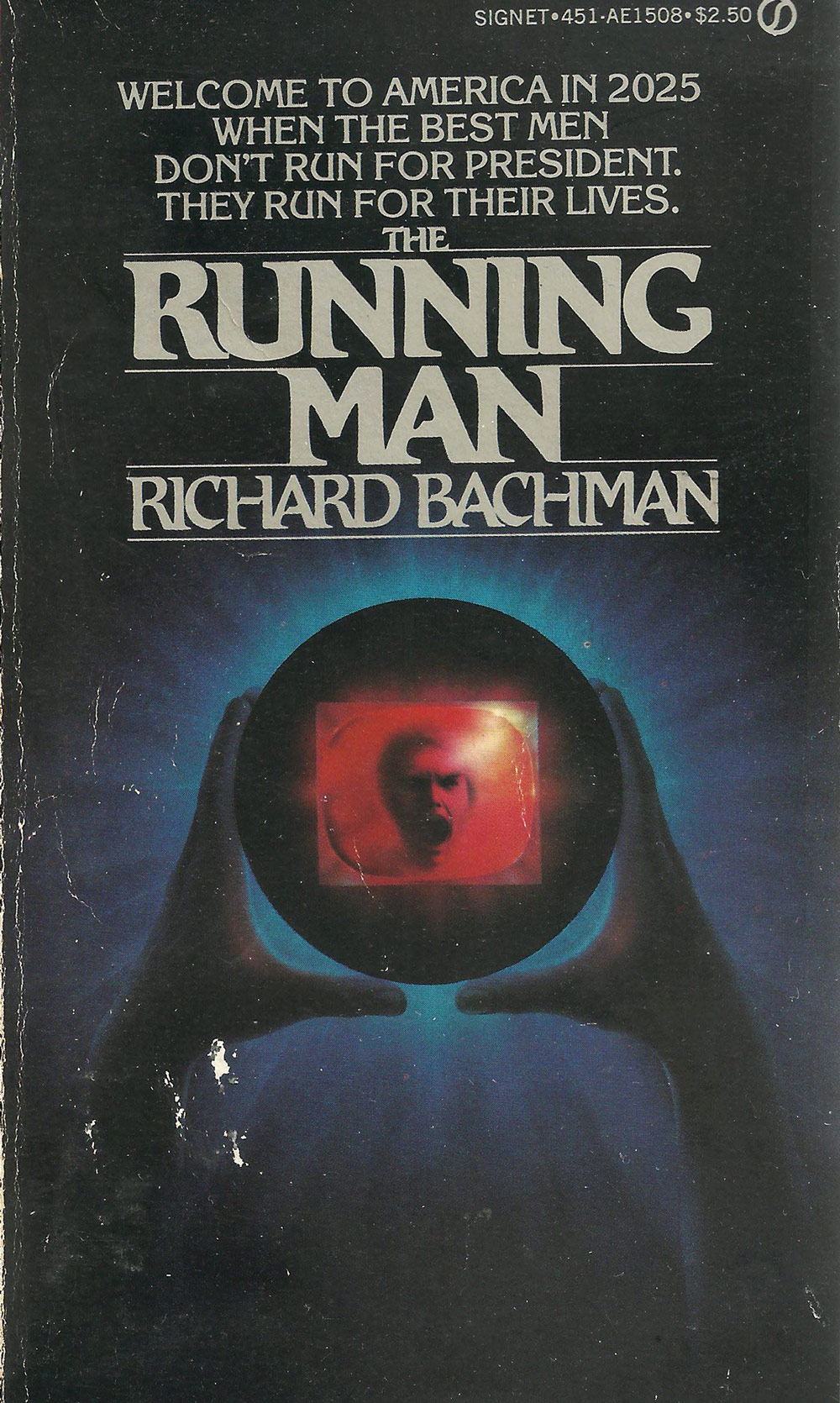
The Running Man (1982)) are relatively short, simple dime novels. They are not horror novels,
per se, nor are they filled with the monsters and supernatural elements we find in
‘Salems Lot or
The Stand. Instead they could all take place in the same drabby dystopian near-future. Even without the ghosts and goblins and psychic powers from his other work, the Bachman novels are as compelling and filled with as much dread and black humor as anything else King had written under his own name.
“I’m a virgin,” Carol said defiantly, startling me up out of my thoughts. She crossed her legs as if to prove it symbolically, then abruptly uncrossed them.
--Rage
While reading these books, one can begin to triangulate the inchoate adolescent political feelings of King as a worried teenager searching for some way to warn his readers of mankind’s pending greed-driven downfall, but while also entertaining them. Warning them of the evils of excess consumption and authoritarian political control; a world where people care more about their status at work or whether or not they live “south of the canal” than care about their families or their neighbors.
This is a world where the people are passive victims of things much larger than themselves. Things they have no control over unless they choose to break the accepted social codes: a police state run rampant, the all-powerful 24-hour news media, reality TV, relentless man-hunters and belligerent fathers reeking of alcohol and motor oil. Rebelling against these titans of evil often comes at the expense of one’s own life.
“A feeling of panic rose in his gullet. He was suddenly and terribly sure that he was looking at the last daylight in his life.”
--The Long Walk

All four novels feel like they could have taken place in the same reality, like peeking into four different rooms in the same seedy motel.
Roadwork gives a bleak view of a coming energy crisis (which with the gas rationing of the late 70s would have felt very real to Mr. King). The stressed out teenagers of
Rage are coming of age in this new world where the progress of civilization is finally beginning to tip back in the opposite direction, shifting back to a darkening age of limited horizons where lives are colored with creeping shadows filled with superstition and rumor.
The Long Walk shows us the next phase of what these kids will go through once the new government regime, paranoid and cold, has created their wicked form of population control.
The Running Man is the final climax where the energy crisis of
Roadwork has led to a totalitarian nightmare where the children of
Rage are now middle-aged and malnourished, living in a dark world devoid of empathy, purpose, and moral clarity.
“They don’t have returnable bottles anymore, either, Georgie. The gospel these days is no deposit, no return. Use it up and throw it out.”
--Roadwork
Rage is the one Bachman book that has received the most press recently, but not for reasons King would have intended. Initially written when King was still in high school in 1965, the book wasn’t published until a decade later after his breakthrough with
Carrie. The book is about a psychologically damaged high school student who brings a gun to school. He shoots dead a math teacher and holds his entire Algebra class hostage. In a 2013 essay entitled "Guns," King acknowledged he wrote the novel in a world very different from the present-day.
“I suppose if it had been written today, and some high school English teacher had seen it, he would have rushed the manuscript to the guidance counselor and I would have found myself in therapy posthaste,” King wrote. “But 1965 was a different world, one where you didn’t have to take off your shoes before boarding a plane and there were no metal detectors at the entrances to high schools.”
What changed between 1965 and 2013 when King wrote the essay? Why are kids so different now? Is it the media? Oppressive government dictates? Drunk fathers? Something in our vegan almond milk lattes? Your guess is as good as King’s. He asked his publishers to remove
Rage from publication after the novel was linked to four real-life school shootings.

Jeffrey Lyne Cox, a senior at San Gabriel High School in California, took a semi-automatic rifle to school on April 26, 1988, and held a humanities class of about 60 students hostage for over 30 minutes. Cox was later tackled and disarmed by another student. A friend of Cox told the press that Cox had been “inspired” by the Kuwait Airways Flight 422 hijacking and by the novel
Rage, which according to the
LA Times reports, Cox had read “over and over” again (it’s a good book and all, but
over and over??).
Dustin L. Pierce, a senior at Jackson County High School in McKee, Kentucky, armed himself with a shotgun and two handguns and took a history classroom hostage in a nine-hour standoff with police on September 18, 1989. The standoff ended without injury. According to a
New York Times report, Police found a copy of
Rage among the possessions in Pierce's bedroom leading to speculation that he had been inspired to carry out the plot of the novel. But which came first: reading the novel or becoming emotionally unhinged to the point of taking hostages at school?
In February 1996, 14-year-old Barry Dale Loukaitis in Washington state was seemingly inspired by
Rage when he shot and killed his algebra teacher and two classmates. He is currently serving two life sentences and an additional 205 years in prison with the possibility of parole in 2021. It was reported on the day of the shooting Loukaitis was dressed as a Wild West-style gunslinger and was wearing a black duster. Based on this information it’s possible
The Dark Tower is the real culprit here. Looks like they got the wrong book!
In December 1997, Michael Carneal shot eight fellow students at a prayer meeting in West Paducah, Kentucky. He had a copy of the book within the Richard Bachman omnibus in his locker. This was the incident that moved King to allow the book to go out of print. Will this move lead a reduction in high school shootings? Or an increase in price-inflated Rage sales in the online economy? If only it were that easy.
“And the Hunters were fearfully, dreadfully good. They would be leaning hard on everyone he knew.”
--The Running Man
Another chilling moment to read for the first time in our post 9/11 world is the climax of
The Running Man. At the end (spoiler alert), protagonist Ben Richards flies a jet airliner filled with fuel into a giant skyscraper in hopes of bringing down the all-powerful Free-Vee network that controls everyone’s putrid lives (granted, Richards willingly and voluntarily signed up for the extreme game show, but that’s beside the point). But Ben Richards was a freedom fighter, not a terrorist.
The link between King and Bachman was eventually exposed after a Washington bookstore clerk named Steve Brown noted similarities between the writing styles of the two authors. “When I read an advance copy of
Thinner,” wrote Brown, “I was no more than two pages into it when I said, ‘This is either Stephen King or the world's best imitator.’”
Brown, putting on his detective hat, located the publisher's records at the Library of Congress. These records included a document naming King as the author of one of Bachman's novels. Brown wrote to King's publishers with a copy of the documents he had uncovered and two weeks later, King telephoned Brown personally and suggested he write an article about how he discovered the truth. At the time of the announcement in 1985, King was working on
Misery, which he had planned to release as a Bachman book as well.
King has written a few more novels under the name of Bachman since 1985 even though we all know the cat is out of the bag. From his perspective I guess it gives him an outlet to deal with different topics and styles, going more for that dog-eared dime-novel one finds on drugstore spin racks, reeling off a good yarn in 300 pages or less. King wrote that he created Bachman as an experiment of sorts, to see if he could duplicate the immense success he had as “Stephen King” under another name. “Is it work that takes you to the top, or is it all just a lottery?” asks King. According to King the question remains unanswered. I would posit that there are ample helpings of both to reach his level of accomplishment.
 "I just know that I want to live my own life. I don't want to be my old man's office boy no more. And as long as I'm in this place I will be. Unless I have my own money. I have to get out of that house and I don't want to owe anybody when I go. My family's driving me crazy. Daddy wants me to be like him and hate my mother. My mother wants me to think like her and hate my father...Everybody wants something from me, you know what I mean? Something they think they can't get anywhere else."